
Go如何实现HTTP请求限流示例
IT行业相对于一般传统行业,发展更新速度更快,一旦停止了学习,很快就会被行业所淘汰。所以我们需要踏踏实实的不断学习,精进自己的技术,尤其是初学者。今天golang学习网给大家整理了《Go如何实现HTTP请求限流示例》,聊聊限流、HTTP,我们一起来看看吧!
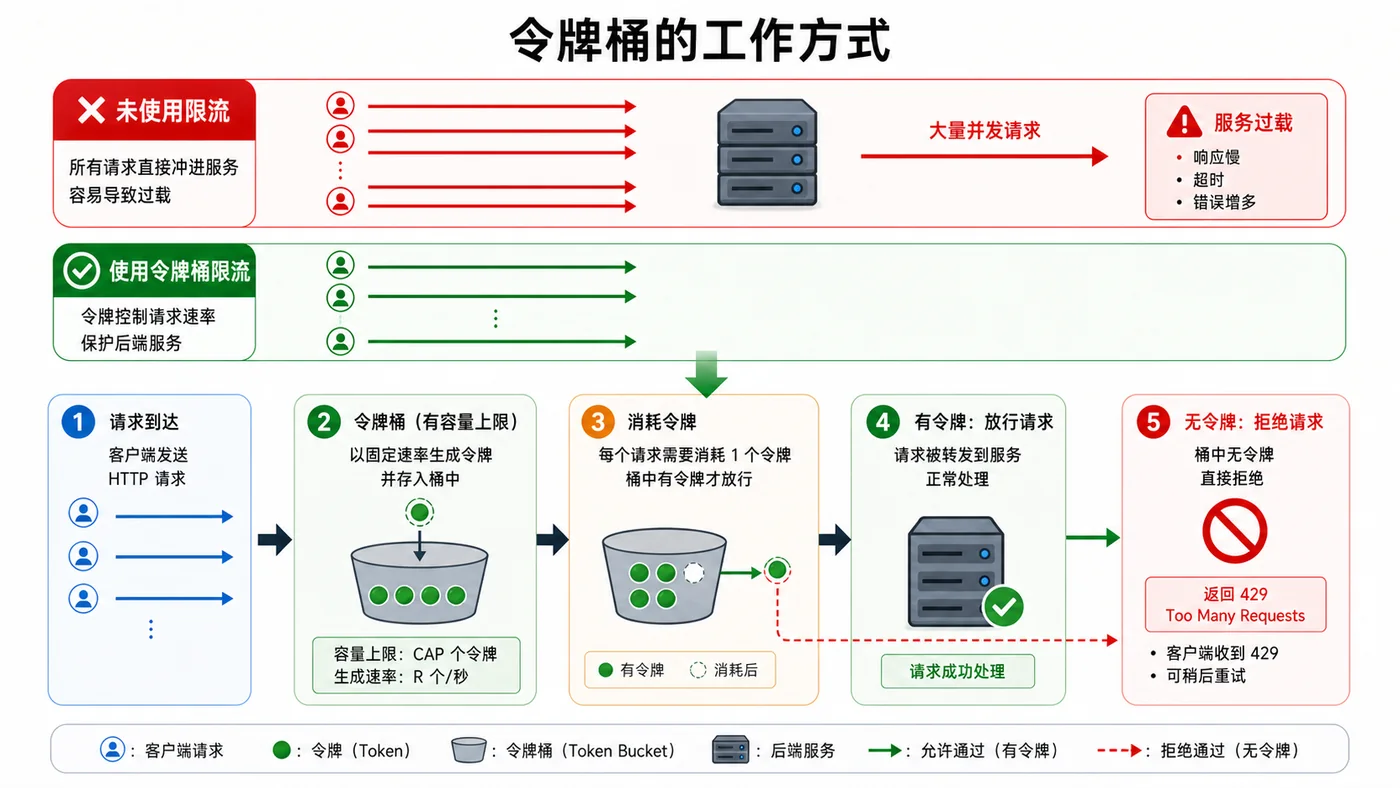
在开发高并发系统时有三把利器用来保护系统:缓存、降级和限流!为了保证在业务高峰期,线上系统也能保证一定的弹性和稳定性,最有效的方案就是进行服务降级了,而限流就是降级系统最常采用的方案之一。
这里为大家推荐一个开源库 https://github.com/didip/tollbooth 但是,如果您想要一些简单的、轻量级的或者只是想要学习的东西,实现自己的中间件来处理速率限制并不困难。今天我们就来聊聊如何实现自己的一个限流中间件
首先我们需要安装一个提供了 Token bucket (令牌桶算法)的依赖包,上面提到的toolbooth 的实现也是基于它实现的
$ go get golang.org/x/time/rate
好了我们先看Demo代码的实现:
limit.go
package main

import (
  "net/http"

  "golang.org/x/time/rate"
)

var limiter = rate.NewLimiter(2, 5)

func limit(next http.Handler) http.Handler {
  return http.HandlerFunc(func(w http.ResponseWriter, r *http.Request) {
    if limiter.Allow() == false {
      http.Error(w, http.StatusText(429), http.StatusTooManyRequests)
      return
    }

    next.ServeHTTP(w, r)
  })
}
main.go
package main

import (
  "net/http"
)

func main() {
  mux := http.NewServeMux()
  mux.HandleFunc("/", okHandler)

  // Wrap the servemux with the limit middleware.
  http.ListenAndServe(":4000", limit(mux))
}

func okHandler(w http.ResponseWriter, r *http.Request) {
  w.Write([]byte("OK"))
}
我们看看 rate.NewLimiter的源码:
// Copyright 2015 The Go Authors. All rights reserved.
// Use of this source code is governed by a BSD-style
// license that can be found in the LICENSE file.

// Package rate provides a rate limiter.
package rate

import (
 "fmt"
 "math"
 "sync"
 "time"

 "golang.org/x/net/context"
)

// Limit defines the maximum frequency of some events.
// Limit is represented as number of events per second.
// A zero Limit allows no events.
type Limit float64

// Inf is the infinite rate limit; it allows all events (even if burst is zero).
const Inf = Limit(math.MaxFloat64)

// Every converts a minimum time interval between events to a Limit.
func Every(interval time.Duration) Limit {
 if interval  burst {
  tokens = burst
 }
 // update state
 r.lim.last = now
 r.lim.tokens = tokens
 if r.timeToAct == r.lim.lastEvent {
  prevEvent := r.timeToAct.Add(r.limit.durationFromTokens(float64(-r.tokens)))
  if !prevEvent.Before(now) {
   r.lim.lastEvent = prevEvent
  }
 }

 return
}

// Reserve is shorthand for ReserveN(time.Now(), 1).
func (lim *Limiter) Reserve() *Reservation {
 return lim.ReserveN(time.Now(), 1)
}

// ReserveN returns a Reservation that indicates how long the caller must wait before n events happen.
// The Limiter takes this Reservation into account when allowing future events.
// ReserveN returns false if n exceeds the Limiter's burst size.
// Usage example:
//  r, ok := lim.ReserveN(time.Now(), 1)
//  if !ok {
//   // Not allowed to act! Did you remember to set lim.burst to be > 0 ?
//  }
//  time.Sleep(r.Delay())
//  Act()
// Use this method if you wish to wait and slow down in accordance with the rate limit without dropping events.
// If you need to respect a deadline or cancel the delay, use Wait instead.
// To drop or skip events exceeding rate limit, use Allow instead.
func (lim *Limiter) ReserveN(now time.Time, n int) *Reservation {
 r := lim.reserveN(now, n, InfDuration)
 return &r
}

// Wait is shorthand for WaitN(ctx, 1).
func (lim *Limiter) Wait(ctx context.Context) (err error) {
 return lim.WaitN(ctx, 1)
}

// WaitN blocks until lim permits n events to happen.
// It returns an error if n exceeds the Limiter's burst size, the Context is
// canceled, or the expected wait time exceeds the Context's Deadline.
func (lim *Limiter) WaitN(ctx context.Context, n int) (err error) {
 if n > lim.burst {
  return fmt.Errorf("rate: Wait(n=%d) exceeds limiter's burst %d", n, lim.burst)
 }
 // Check if ctx is already cancelled
 select {
 case  maxElapsed {
  elapsed = maxElapsed
 }

 // Calculate the new number of tokens, due to time that passed.
 delta := lim.limit.tokensFromDuration(elapsed)
 tokens := lim.tokens + delta
 if burst := float64(lim.burst); tokens > burst {
  tokens = burst
 }

 return now, last, tokens
}

// durationFromTokens is a unit conversion function from the number of tokens to the duration
// of time it takes to accumulate them at a rate of limit tokens per second.
func (limit Limit) durationFromTokens(tokens float64) time.Duration {
 seconds := tokens / float64(limit)
 return time.Nanosecond * time.Duration(1e9*seconds)
}

// tokensFromDuration is a unit conversion function from a time duration to the number of tokens
// which could be accumulated during that duration at a rate of limit tokens per second.
func (limit Limit) tokensFromDuration(d time.Duration) float64 {
 return d.Seconds() * float64(limit)
}
算法描述:
用户配置的平均发送速率为r,则每隔1/r秒一个令牌被加入到桶中(每秒会有r个令牌放入桶中),桶中最多可以存放b个令牌。如果令牌到达时令牌桶已经满了,那么这个令牌会被丢弃;
实现用户粒度的限流
虽然在某些情况下使用单个全局速率限制器非常有用,但另一种常见情况是基于IP地址或API密钥等标识符为每个用户实施速率限制器。我们将使用IP地址作为标识符。简单实现代码如下:
package main
import (
  "net/http"
  "sync"
  "time"

  "golang.org/x/time/rate"
)

// Create a custom visitor struct which holds the rate limiter for each
// visitor and the last time that the visitor was seen.
type visitor struct {
  limiter *rate.Limiter
  lastSeen time.Time
}

// Change the the map to hold values of the type visitor.
var visitors = make(map[string]*visitor)
var mtx sync.Mutex
// Run a background goroutine to remove old entries from the visitors map.
func init() {
  go cleanupVisitors()
}

func addVisitor(ip string) *rate.Limiter {
  limiter := rate.NewLimiter(2, 5)
  mtx.Lock()
  // Include the current time when creating a new visitor.
  visitors[ip] = &visitor{limiter, time.Now()}
  mtx.Unlock()
  return limiter
}

func getVisitor(ip string) *rate.Limiter {
  mtx.Lock()
  v, exists := visitors[ip]
  if !exists {
    mtx.Unlock()
    return addVisitor(ip)
  }
  // Update the last seen time for the visitor.
  v.lastSeen = time.Now()
  mtx.Unlock()
  return v.limiter
}

// Every minute check the map for visitors that haven't been seen for
// more than 3 minutes and delete the entries.
func cleanupVisitors() {
  for {
    time.Sleep(time.Minute)
    mtx.Lock()
    for ip, v := range visitors {
      if time.Now().Sub(v.lastSeen) > 3*time.Minute {
        delete(visitors, ip)
      }
    }
    mtx.Unlock()
  }
}

func limit(next http.Handler) http.Handler {
  return http.HandlerFunc(func(w http.ResponseWriter, r *http.Request) {
    limiter := getVisitor(r.RemoteAddr)
    if limiter.Allow() == false {
      http.Error(w, http.StatusText(429), http.StatusTooManyRequests)
      return
    }
    next.ServeHTTP(w, r)
  })
}
当然这只是一个简单的实现方案,如果我们要在微服务的API-GateWay中去实现限流还是要考虑很多东西的。建议大家可以看看 https://github.com/didip/tollbooth 的源码。
今天关于《Go如何实现HTTP请求限流示例》的内容就介绍到这里了,是不是学起来一目了然!想要了解更多关于golang的内容请关注golang学习网公众号!
 解读golang plugin热更新尝试
- 上一篇
- 解读golang plugin热更新尝试
- 下一篇
- golang中for循环遍历channel时需要注意的问题详解
-

- 烂漫的黑夜
- 真优秀,一直没懂这个问题,但其实工作中常常有遇到...不过今天到这,看完之后很有帮助,总算是懂了,感谢楼主分享技术贴!
- 2023-03-01 20:25:01
-
- 欢喜的导师
- 这篇博文太及时了,太详细了,受益颇多,已加入收藏夹了,关注作者了!希望作者能多写Golang相关的文章。
- 2023-01-30 14:17:39
-
- 烂漫的黑夜
- 受益颇多,一直没懂这个问题,但其实工作中常常有遇到...不过今天到这,帮助很大,总算是懂了,感谢大佬分享技术贴!
- 2023-01-29 02:36:47
-
- 寂寞的热狗
- 这篇文章内容真及时,太细致了,太给力了,mark,关注老哥了!希望老哥能多写Golang相关的文章。
- 2023-01-23 12:33:29
-
- 怕孤独的薯片
- 这篇博文真是及时雨啊,太全面了,很好,码起来,关注up主了!希望up主能多写Golang相关的文章。
- 2023-01-21 06:49:37
-
- 多情的唇膏
- 很有用,一直没懂这个问题,但其实工作中常常有遇到...不过今天到这,帮助很大,总算是懂了,感谢作者分享文章!
- 2023-01-17 09:35:55
-
- 无聊的过客
- 这篇技术贴出现的刚刚好,细节满满,真优秀,收藏了,关注楼主了!希望楼主能多写Golang相关的文章。
- 2023-01-17 07:47:37
-
- 温暖的麦片
- 很详细,收藏了,感谢作者的这篇博文,我会继续支持!
- 2023-01-17 03:07:01
-
- 羞涩的滑板
- 赞 ??,一直没懂这个问题,但其实工作中常常有遇到...不过今天到这,帮助很大,总算是懂了,感谢楼主分享文章内容!
- 2023-01-12 20:23:37
-
- 糟糕的黑裤
- 太全面了,已加入收藏夹了,感谢老哥的这篇文章内容,我会继续支持!
- 2023-01-10 13:52:41
-
- 俏皮的画板
- 这篇文章内容真是及时雨啊,太全面了,赞 ??,码住,关注老哥了!希望老哥能多写Golang相关的文章。
- 2023-01-07 13:16:09
-
- Golang · Go教程 | 1天前 | map · 并发安全 · RWMutex · sync.Map · Go教程 · 并发安全 RWMutex sync.Map Go map并发读写 go test race
- Go map 并发读写崩溃怎么办:从复现报错到 RWMutex 修复的完整流程
- 272浏览 收藏
-
- Golang · Go教程 | 3天前 | singleflight · 并发控制 · Go教程 · 缓存治理 · 接口优化 · Go 并发请求 缓存击穿 singleflight 缓存回填
- Go singleflight 防缓存击穿实战:相同请求只查一次数据库
- 114浏览 收藏
-

- 前端进阶之JavaScript设计模式
- 设计模式是开发人员在软件开发过程中面临一般问题时的解决方案,代表了最佳的实践。本课程的主打内容包括JS常见设计模式以及具体应用场景,打造一站式知识长龙服务,适合有JS基础的同学学习。
- 543次学习
-

- GO语言核心编程课程
- 本课程采用真实案例,全面具体可落地,从理论到实践,一步一步将GO核心编程技术、编程思想、底层实现融会贯通,使学习者贴近时代脉搏,做IT互联网时代的弄潮儿。
- 516次学习
-

- 简单聊聊mysql8与网络通信
- 如有问题加微信:Le-studyg;在课程中,我们将首先介绍MySQL8的新特性,包括性能优化、安全增强、新数据类型等,帮助学生快速熟悉MySQL8的最新功能。接着,我们将深入解析MySQL的网络通信机制,包括协议、连接管理、数据传输等,让
- 500次学习
-

- JavaScript正则表达式基础与实战
- 在任何一门编程语言中,正则表达式,都是一项重要的知识,它提供了高效的字符串匹配与捕获机制,可以极大的简化程序设计。
- 487次学习
-

- 从零制作响应式网站—Grid布局
- 本系列教程将展示从零制作一个假想的网络科技公司官网,分为导航,轮播,关于我们,成功案例,服务流程,团队介绍,数据部分,公司动态,底部信息等内容区块。网站整体采用CSSGrid布局,支持响应式,有流畅过渡和展现动画。
- 485次学习
-

- ljg-skills
- ljg-skills 是李继刚开源的 AI 技能与提示词集合,面向大模型使用者整理了一批可复用的 prompt、角色设定和任务技能模板,适合用于学习提示词设计、搭建个人 AI 工作流和沉淀团队常用智能体能力。
- 297次使用
-

- MELO音乐
- MELO音乐是一站式AI视频与音乐制作助手,对标suno, udio的高品质体验。提供伴奏生成、原创写词、无损导出、哼唱识曲、混音变声等全套音频与短视频编辑工具。无论是流行Kpop、电音说唱、民谣古风、摇滚儿歌还是商用轻音乐,MELO为你免费谱曲,轻松做同款!
- 314次使用
-

- UniScribe
- UniScribe 是一款 AI 音视频转文字与内容整理工具,支持上传音频、视频文件或粘贴 YouTube 链接,自动生成转写文本、摘要、思维导图和关键问题,并支持多格式导出,适合会议记录、课程学习、访谈整理和内容创作复盘。
- 283次使用
-

- 剧云
- 剧云是专业中文剧本创作平台,安全稳定运行十余年,集成AI编剧、剧本医生审核、人物小传、剧情关系图、大纲编写、多人协作、Word导入导出、版权管控功能,数据安全防护,轻松高效创作剧本。
- 462次使用
-

- 万象有声
- 万象有声,一个专为有声创作者打造的新一代智能有声内容创作平台。平台提供专业的智能拆章、智能画本编辑、AI配音、AI生成音效、后期制作、智能对轨、智能审听等有声创作全流程工具,可以帮助创作者高效、低成本创作出引人入胜的有声作品。立即体验,让有声书制作更简单!
- 446次使用
-
- HTTP 的 response 中的响应体和头部是分开发送的吗?
- 2023-01-28 387浏览
-
- Go语言框架快速集成限流中间件详解
- 2022-12-23 290浏览
-
- B站等视频网站的弹幕用的是 websocket 还是轮询?
- 2023-02-16 447浏览
-
- Golang官方限流器库实现限流示例详解
- 2023-01-07 376浏览
-
- Golang实现HTTP编程请求和响应
- 2022-12-28 101浏览


