
Golang AES解密机制只给出另一个密文作为输出
来源:stackoverflow
2024-02-10 16:27:24
0浏览
收藏
“纵有疾风来,人生不言弃”,这句话送给正在学习Golang的朋友们,也希望在阅读本文《Golang AES解密机制只给出另一个密文作为输出》后,能够真的帮助到大家。我也会在后续的文章中,陆续更新Golang相关的技术文章,有好的建议欢迎大家在评论留言,非常感谢!
问题内容
我正在尝试在我的 go 应用程序中使用以下解密方法(通过互联网找到)。我拥有的 cipherkey 不是简单的 32 位密钥,但它看起来是 base64 编码的。因此,我先解码然后应用。在整个解密过程中我没有收到任何错误,但是此解密方法的输出看起来是另一个密文。
不确定我是否遗漏了 cipherkey 方面的内容。
func decrypt(key []byte, secure string) (decoded string, err error) {
    //remove base64 encoding:
    ciphertext, err := base64.stdencoding.decodestring(secure)

    //if decodestring failed, exit:
    if err != nil {
        return
    }

    //create a new aes cipher with the key and encrypted message
    block, err := aes.newcipher(key)

    //if newcipher failed, exit:
    if err != nil {
        return
    }

    //if the length of the ciphertext is less than 16 bytes:
    if len(ciphertext) < aes.blocksize {
        err = errors.new("ciphertext block size is too short")
        return
    }

    iv := ciphertext[:aes.blocksize]
    ciphertext = ciphertext[aes.blocksize:]
    fmt.println("before deciphering: ", string(ciphertext))

    //decrypt the message
    stream := cipher.newcfbdecrypter(block, iv)
    stream.xorkeystream(ciphertext, ciphertext)

    return string(ciphertext), err
}
更新原始问题...
我必须解密 go 应用程序中的数据。数据又来自 java 应用程序。以下是相同的片段,
public static final string key_algorithm = "aes";
public static final string aes_algorithm = "aes/cfb8/nopadding";
public static final string digest_algorithm = "md5";
public static final byte[] initial_vector = { -25, 9, -119, 91, -90, 112, 98, -40, 65, -106, -1, 96, 118, -13, 88,
                85 };
package com.crypto;

import static com.cryptoconstant.aes_algorithm;
import static com.cryptoconstant.digest_algorithm;
import static com.cryptoconstant.initial_vector;
import static com.cryptoconstant.key_algorithm;

import java.math.biginteger;
import java.nio.charset.standardcharsets;
import java.security.invalidalgorithmparameterexception;
import java.security.invalidkeyexception;
import java.security.messagedigest;
import java.security.nosuchalgorithmexception;
import java.util.base64;

import javax.crypto.badpaddingexception;
import javax.crypto.cipher;
import javax.crypto.illegalblocksizeexception;
import javax.crypto.nosuchpaddingexception;
import javax.crypto.spec.ivparameterspec;
import javax.crypto.spec.secretkeyspec;

import org.springframework.beans.factory.annotation.value;
import org.springframework.stereotype.component;

import lombok.extern.slf4j.slf4j;


@slf4j
@component
public class messagecrypto {

    /**
     *
     */
    @value("${design.secret.key}")
    private string designsecretkey;

    /**
     * md 5
     *
     * @param input the input
     * @return the string
     * @throws nosuchalgorithmexception the no such algorithm exception
     */
    private static string md5(final string input) throws nosuchalgorithmexception {
        final messagedigest md = messagedigest.getinstance(digest_algorithm);
        final byte[] messagedigest = md.digest(input.getbytes());
        // convert byte array to a string of hex digits
        final biginteger number = new biginteger(1, messagedigest);
        // the 0 in the mask does the padding, 32 chars and x indicates lower hex
        // digits.
        return string.format("%032x", number);
    }

    /**
     * inits the cipher
     *
     * @param mode the mode
     * @return the cipher
     * @throws nosuchalgorithmexception           the no such algorithm exception
     * @throws nosuchpaddingexception             the no such padding exception
     * @throws invalidkeyexception                the invalid key exception
     * @throws invalidalgorithmparameterexception the invalid algorithm parameter
     *                                            exception
     */
    private cipher initcipher(final int mode) throws nosuchalgorithmexception, nosuchpaddingexception,
            invalidkeyexception, invalidalgorithmparameterexception {

        final secretkeyspec skeyspec = new secretkeyspec(md5(designsecretkey).getbytes(), key_algorithm);
        final ivparameterspec initialvector = new ivparameterspec(initial_vector);
        final cipher cipher = cipher.getinstance(aes_algorithm);
        cipher.init(mode, skeyspec, initialvector);
        return cipher;
    }

    /**
     * encrypt
     *
     * @param datatoencrypt the data to encrypt
     * @return the string
     */
    public string encrypt(final string datatoencrypt) {
        log.info("processing encrypt...");
        byte[] encrypteddata = {};

        try {

            // initialize the cipher
            final cipher cipher = initcipher(cipher.encrypt_mode);
            // encrypt the data
            final byte[] encryptedbytearray = cipher.dofinal(datatoencrypt.getbytes());
            // encode using base64
            encrypteddata = base64.getencoder().encode(encryptedbytearray);

        } catch (illegalblocksizeexception | badpaddingexception | nosuchalgorithmexception | nosuchpaddingexception
                | invalidalgorithmparameterexception | invalidkeyexception e) {
            log.error("encryption error: {} ", e);
        }
        log.info("processed encrypt...");
        return new string(encrypteddata);
    }

    /**
     * decrypt
     *
     * @param encrypteddata the encrypted data
     * @return the string
     */
    public string decrypt(final string encrypteddata) {
        log.info("processing decrypt...");
        string decrypteddata = "";

        try {

            // initialize the cipher
            final cipher cipher = initcipher(cipher.decrypt_mode);
            // decode using base64
            final byte[] encryptedbytearray = base64.getdecoder().decode(encrypteddata.getbytes());
            // decrypt the data
            final byte[] decryptedbytearray = cipher.dofinal(encryptedbytearray);

            decrypteddata = new string(decryptedbytearray, standardcharsets.utf_8);

        } catch (illegalblocksizeexception | badpaddingexception | nosuchalgorithmexception | nosuchpaddingexception
                | invalidalgorithmparameterexception | invalidkeyexception e) {
            log.error("decryption error: {} ", e);
        }
        log.info("processed decrypt...");
        return decrypteddata;
    }

}
我已经从他们那里收到了密钥和密文。现在我需要在 go 中实现与此 java 等效的东西。我正在尝试使用 cfb 加密/解密机制,这似乎很容易实现。但是,我正在尝试弄清楚如何从提供的密钥中检索实际的密钥。从 java 代码来看,我需要有一些与 md5() 方法在 java 中执行的操作等效的操作。
这是我尝试过的东西,
key := "94k/IwqJQ5wf4Yt5JZmbW85r2x246rI3g3LZbTI80Vo="
key_decr := md5.Sum([]byte(key))
key = hex.EncodeToString(key_decr[:])
log.Println("key:", key)
decrypt(key, secureText)
但是,这不起作用。
正确答案
这两个代码有两点不同:
- java 代码使用 cfb8,go 代码使用 cfb128。
- java 代码在加密过程中不会执行 iv 和密文的串联,但 go 代码会假设这种串联,因此在解密过程中将 iv 和密文分开。
为了使两种代码兼容,必须消除这些差异。由于java代码似乎是参考,因此go代码中需要进行以下更改:
- 将删除加密数据到 iv 和密文的分离。因此,数据必须至少为 16 字节大的约束以及其检查也被省略。将使用 java 代码中的静态 iv(java 代码的负二进制补码整数通过添加 256 转换为无符号整数):
iv := []byte{231, 9, 137, 91, 166, 112, 98, 216, 65, 150, 255, 96, 118, 243, 88, 85} - 在 go 代码中将使用 cfb8。 crypto/cipher 包实现了具有固定段大小的 cfb128,因此无法使用。 cfb8 实现的可能替代方案是 github.com/tnze/gomcbot/cfb8 :
stream := cfb8.newcfb8decrypt(block, iv)
总体(为了简单起见,没有异常处理):
import (
    "crypto/aes"
    "crypto/md5"
    "encoding/base64"
    "encoding/hex"
    "log"
    "github.com/Tnze/gomcbot/CFB8"
)

func main() {
    key := "94k/IwqJQ5wf4Yt5JZmbW85r2x246rI3g3LZbTI80Vo="
    keyHashed := md5.Sum([]byte(key))
    keyHex := hex.EncodeToString(keyHashed[:])
    cipherText := "h6OpNEE4g8hjyJl5lk5Qm4ZyXP/j3ADWqREolDL8lwb0LuyDqQdrlLGfsg==" // Ciphertext from the Java side (created with AES/CFB8)
    decryptedText, _ := decrypt([]byte(keyHex), cipherText)
    log.Println(decryptedText)
}

func decrypt(key []byte, cipherTextB64 string) (decrypted string, err error) {
    cipherText, _ := base64.StdEncoding.DecodeString(cipherTextB64)                      // Fix 1: don't separate IV and ciphertext
    iv := []byte{231, 9, 137, 91, 166, 112, 98, 216, 65, 150, 255, 96, 118, 243, 88, 85} // Fix 2: apply the static IV from the Java side
    block, _ := aes.NewCipher(key)
    stream := CFB8.NewCFB8Decrypt(block, iv) // Fix 3: apply CFB8
    stream.XORKeyStream(cipherText, cipherText)
    return string(cipherText), nil
}
关于安全:
- 静态 iv 是一个漏洞,因为这会导致密钥/iv 对的重复使用。为了避免这种情况,通常在加密过程中生成一个随机 iv 并与密文连接(注意 iv 不是秘密的)。在解密过程中,两个部分是分开的(顺便说一下,这对应于原始 go 代码中的实现)。
- 通过快速且不安全的摘要(例如 md5)从密码派生密钥是一个漏洞。使用pbkdf2等密钥导出函数更安全。
今天关于《Golang AES解密机制只给出另一个密文作为输出》的内容就介绍到这里了,是不是学起来一目了然!想要了解更多关于的内容请关注golang学习网公众号!
版本声明
本文转载于:stackoverflow 如有侵犯,请联系study_golang@163.com删除
 防止单引号在插入SQL时产生的方法
- 上一篇
- 防止单引号在插入SQL时产生的方法
- 下一篇
- 使用 ObjectBox Go 编译的二进制文件的 部署/重新分发方案
查看更多
最新文章
-

- Golang · Go问答 | 1小时前 | interface · 单元测试 · 架构设计 · repository · Go问答 · 单元测试 架构设计 interface 接口设计 Go问答 调用方定义 Repository
- Go interface 应该放在哪一层?为什么更推荐调用方定义小接口
- 212浏览 收藏
-

- Golang · Go问答 | 1小时前 | JSON · time.Time · 接口设计 · Go问答 · encoding/json · encoding/json API响应 JSON序列化 time.Time omitempty Go问答 omitzero
- Go JSON 里的 omitempty 为什么漏不掉 time.Time?omitzero 和指针怎么选
- 315浏览 收藏
-
- Golang · Go问答 | 2小时前 | JSON · 后端开发 · Go问答 · encoding/json · 接口解析 · JSON解析 encoding/json DisallowUnknownFields Go问答 RawMessage json.Decoder UseNumber
- Go 解析 JSON 怎么选:struct、map、RawMessage 还是 Decoder
- 151浏览 收藏
-

- Golang · Go问答 | 21小时前 | HTTP · net/http · Go问答 · 流式响应 · ResponseController · net/http FLUSH 流式响应 Go问答 ResponseController FullDuplex 写超时
- Go http.ResponseController 有什么用?Flush、写超时和 FullDuplex 这样理解
- 161浏览 收藏
-
- Golang · Go问答 | 22小时前 | HTTP · sse · Go问答 · 用户体验 · 流式响应 · Go EventSource SSE Go问答 Server-Sent Events 长任务进度 http.Flusher
- Go 长任务接口怎么返回进度?SSE 流式推送的最小写法
- 293浏览 收藏
-
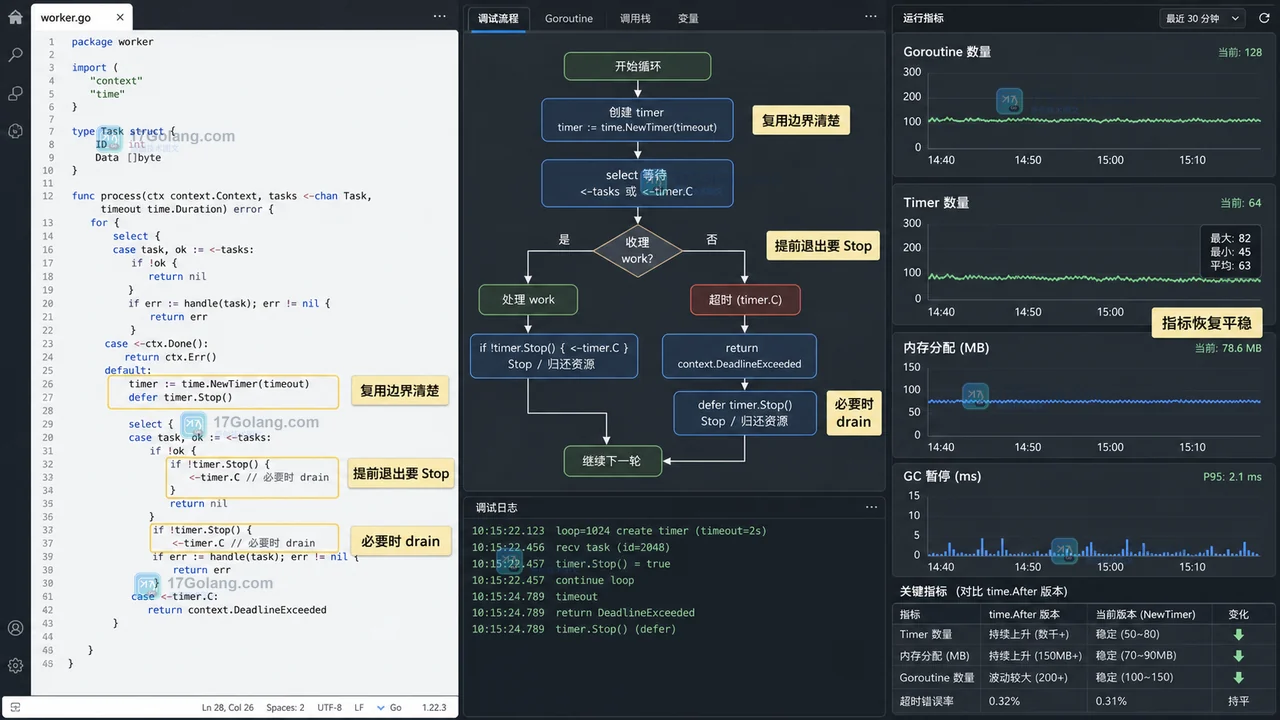
- Golang · Go问答 | 22小时前 | Timer · 性能优化 · time.After · Go问答 · Go 内存优化 Timer time.After Go问答 time.NewTimer Go1.23
- Go time.After 放在循环里还会泄漏吗?从 Go 1.23 变化到工程写法
- 384浏览 收藏
-
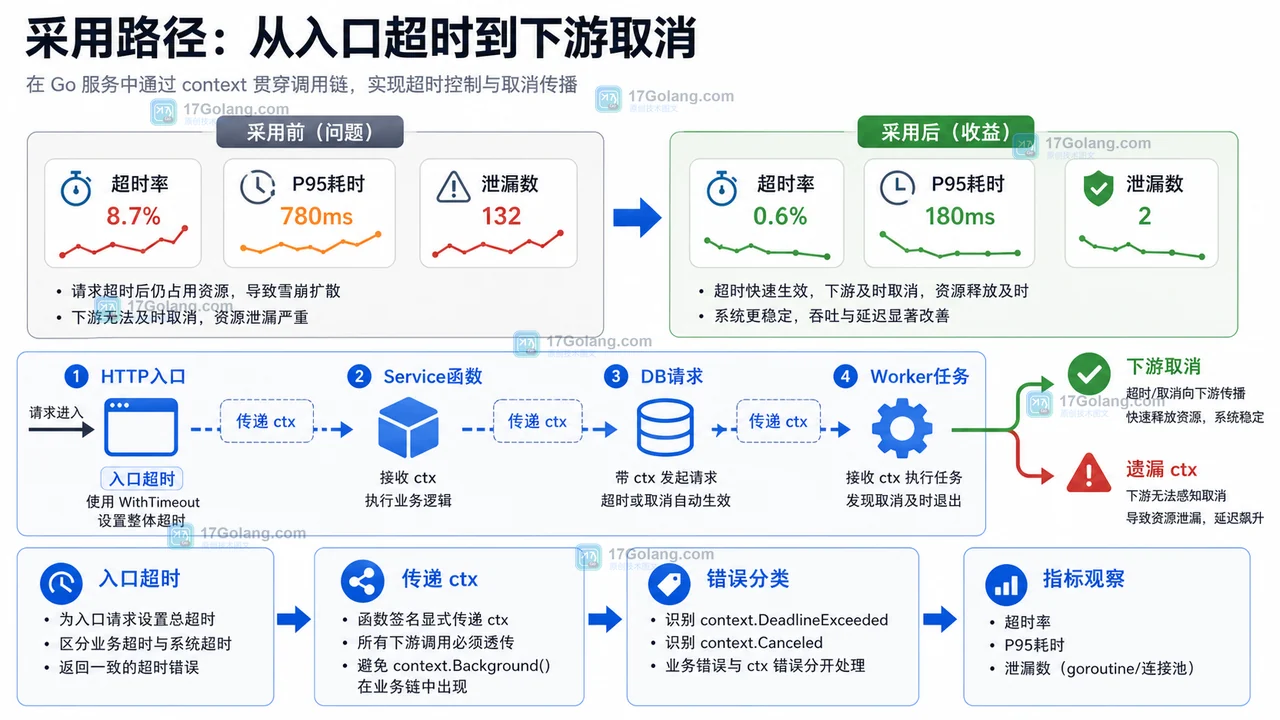
- Golang · Go问答 | 1天前 | go · Context · 并发编程 · 接口超时 · 超时控制 goroutine泄漏 WithTimeout Go context Go问答 CancelFunc
- Go context 超时取消为什么重要:从接口耗时到 goroutine 泄漏的治理思路
- 477浏览 收藏

查看更多
课程推荐
-

- 前端进阶之JavaScript设计模式
- 设计模式是开发人员在软件开发过程中面临一般问题时的解决方案,代表了最佳的实践。本课程的主打内容包括JS常见设计模式以及具体应用场景,打造一站式知识长龙服务,适合有JS基础的同学学习。
- 543次学习
-

- GO语言核心编程课程
- 本课程采用真实案例,全面具体可落地,从理论到实践,一步一步将GO核心编程技术、编程思想、底层实现融会贯通,使学习者贴近时代脉搏,做IT互联网时代的弄潮儿。
- 516次学习
-

- 简单聊聊mysql8与网络通信
- 如有问题加微信:Le-studyg;在课程中,我们将首先介绍MySQL8的新特性,包括性能优化、安全增强、新数据类型等,帮助学生快速熟悉MySQL8的最新功能。接着,我们将深入解析MySQL的网络通信机制,包括协议、连接管理、数据传输等,让
- 500次学习
-

- JavaScript正则表达式基础与实战
- 在任何一门编程语言中,正则表达式,都是一项重要的知识,它提供了高效的字符串匹配与捕获机制,可以极大的简化程序设计。
- 487次学习
-

- 从零制作响应式网站—Grid布局
- 本系列教程将展示从零制作一个假想的网络科技公司官网,分为导航,轮播,关于我们,成功案例,服务流程,团队介绍,数据部分,公司动态,底部信息等内容区块。网站整体采用CSSGrid布局,支持响应式,有流畅过渡和展现动画。
- 485次学习
查看更多
AI推荐
-

- ljg-skills
- ljg-skills 是李继刚开源的 AI 技能与提示词集合,面向大模型使用者整理了一批可复用的 prompt、角色设定和任务技能模板,适合用于学习提示词设计、搭建个人 AI 工作流和沉淀团队常用智能体能力。
- 3312次使用
-

- MELO音乐
- MELO音乐是一站式AI视频与音乐制作助手,对标suno, udio的高品质体验。提供伴奏生成、原创写词、无损导出、哼唱识曲、混音变声等全套音频与短视频编辑工具。无论是流行Kpop、电音说唱、民谣古风、摇滚儿歌还是商用轻音乐,MELO为你免费谱曲,轻松做同款!
- 3061次使用
-

- UniScribe
- UniScribe 是一款 AI 音视频转文字与内容整理工具,支持上传音频、视频文件或粘贴 YouTube 链接,自动生成转写文本、摘要、思维导图和关键问题,并支持多格式导出,适合会议记录、课程学习、访谈整理和内容创作复盘。
- 3005次使用
-

- 剧云
- 剧云是专业中文剧本创作平台,安全稳定运行十余年,集成AI编剧、剧本医生审核、人物小传、剧情关系图、大纲编写、多人协作、Word导入导出、版权管控功能,数据安全防护,轻松高效创作剧本。
- 3220次使用
-

- 万象有声
- 万象有声,一个专为有声创作者打造的新一代智能有声内容创作平台。平台提供专业的智能拆章、智能画本编辑、AI配音、AI生成音效、后期制作、智能对轨、智能审听等有声创作全流程工具,可以帮助创作者高效、低成本创作出引人入胜的有声作品。立即体验,让有声书制作更简单!
- 3174次使用
查看更多
相关文章
-
- 用Nginx反向代理部署go写的网站。
- 2023-01-17 502浏览
-
- GoLand调式动态执行代码
- 2023-01-13 502浏览
-
- 从不同的 go 例程将数据写入同一通道无需等待组即可正常工作
- 2024-04-29 501浏览
-
- Golang rsa-oaep解密失败,前端使用webcrypto
- 2024-04-26 501浏览
-
- 如何从用户输入以惰性方式初始化包的全局变量?
- 2024-04-24 501浏览


