
Why does a pointer to a local variable escape to the heap?
golang学习网今天将给大家带来《Why does a pointer to a local variable escape to the heap?》,感兴趣的朋友请继续看下去吧!以下内容将会涉及到golang等等知识点,如果你是正在学习Golang或者已经是大佬级别了,都非常欢迎也希望大家都能给我建议评论哈~希望能帮助到大家!
问题内容
Here is my go environment:
[lorneli@localhost GoTest]$ go version
go version go1.9 linux/amd64
Here is my program:
package main

type request struct {
    ID string
    size uint32
    off uint64
}

func main() {
    r := request{}
    iter := interface{}(&r) // &r escapes to heap
    iters := make([]interface{}, 0)
    iters = append(iters, iter)
}
I allocate a request instance and convert the pointer of it to
interface{}. But when analysing with flag -gcflags "-m" , I found out the
instance escapes to heap when converting. Why this happens?
Here is analysing result:
[lorneli@localhost GoTest]$ go build -gcflags "-m"
# _/mnt/hgfs/vmfolder/workspace/GoTest
./main.go:9:6: can inline main
./main.go:11:21: (interface {})(&r) escapes to heap
./main.go:11:22: &r escapes to heap
./main.go:10:15: moved to heap: r
./main.go:12:15: main make([]interface {}, 0) does not escape
I think this case doesn't match any cases listed on "Go Escape Analysis Flaws".
正确答案
Simplify your example. Analyze with -gcflags='-m -m'.
Example 1 :
package main

func main() {
    var v int
    s := make([]*int, 0)
    s = append(s, &v) // &v escapes to heap
}
Output:
$ go version
go version devel +df8c2b905b Tue Mar 6 06:13:17 2018 +0000 linux/amd64
$ go run -gcflags='-m -m' esc.go
# command-line-arguments
./esc.go:3:6: can inline main as: func() { var v int; v = ; s := make([]*int, 0); s = append(s, &v) }
./esc.go:6:16: &v escapes to heap
./esc.go:6:16:  from append(s, &v) (appended to slice) at ./esc.go:6:12
./esc.go:4:6: moved to heap: v
./esc.go:5:11: main make([]*int, 0) does not escape
$
Escape analysis determines whether any references to a value escape the
function in which the value is declared. A reference to the variable v,
declared in function main, escapes as an argument to function append: &v escapes to heap from append(s, &v), moved to heap: v.
Example 2 :
package main

func main() {
    var v int
    lc := 1
    s := make([]*int, lc)
    s[0] = &v
}

$ go run -gcflags='-m -m' esc2.go
./esc2.go:3:6: can inline main as: func() { var v int; v = ; lc := 1; s := make([]*int, lc); s[0] = &v }
./esc2.go:6:11: make([]*int, lc) escapes to heap
./esc2.go:6:11:     from make([]*int, lc) (too large for stack) at ./esc2.go:6:11
./esc2.go:7:9: &v escapes to heap
./esc2.go:7:9:  from s[0] (slice-element-equals) at ./esc2.go:7:7
./esc2.go:4:6: moved to heap: v
$
type slice struct {
    array unsafe.Pointer
    len   int
    cap   int
}
make for a slice returns a slice descriptor struct (pointer to underlying
array, length, and capacity) and allocates an underlying slice element array.
The underlying array is generally allocated on the heap: make([]*int, lc) escapes to heap from make([]*int, lc).
s[0] = &v stores a reference to the variable v (&v) in the underlying
array on the heap: &v escapes to heap from s[0] (slice-element-equals),
moved to heap: v. The reference remains on the heap, after the function ends
and its stack is reclaimed, until the underlying array is garbage collected.
If the make slice capacity is a small (compile time) constant, make([]*int, 1) in your example, the underlying array may be allocated on the stack.
However, escape analysis does not take this into account.
以上就是本文的全部内容了,是否有顺利帮助你解决问题?若是能给你带来学习上的帮助,请大家多多支持golang学习网!更多关于Golang的相关知识,也可关注golang学习网公众号。
 使用 mgo 进行部分更新
- 上一篇
- 使用 mgo 进行部分更新

- 下一篇
- partial update using mgo
-
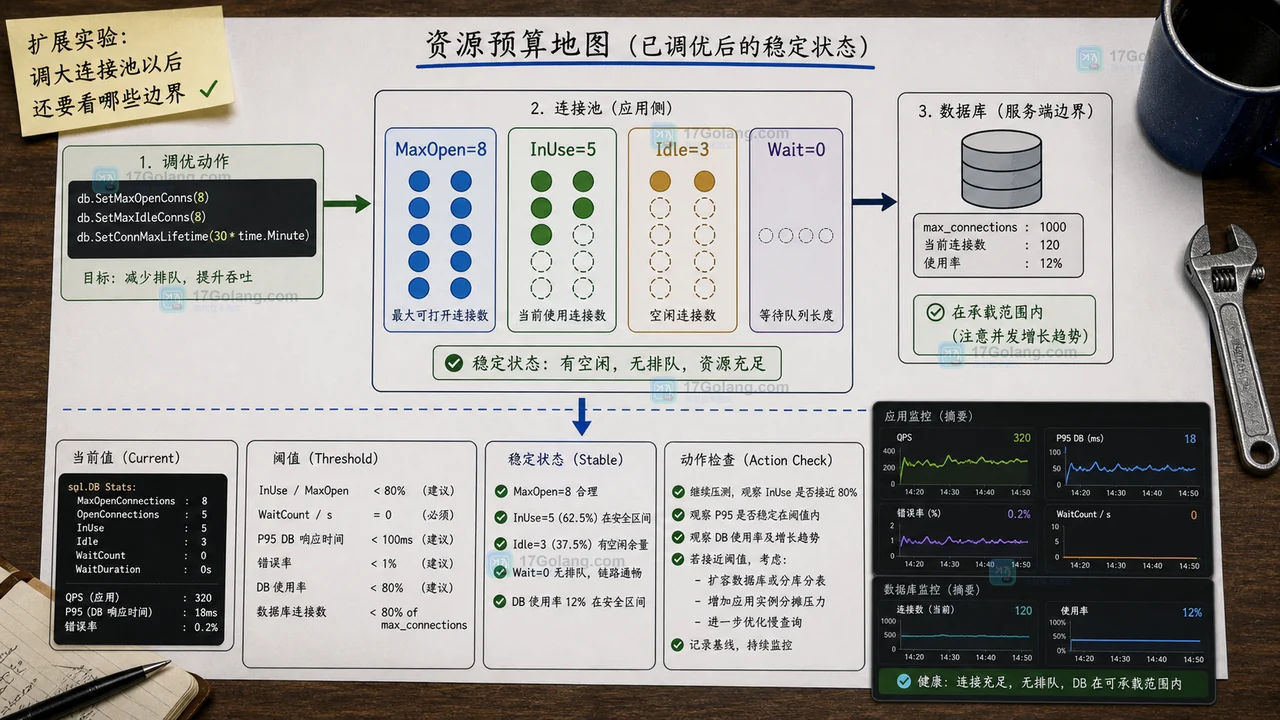
- Golang · Go问答 | 10小时前 | 连接池 · 性能排查 · database/sql · Go问答 · Go 连接池 DBStats sql.DB WaitCount SetMaxOpenConns
- Go sql.DB WaitCount 为什么增长:用小实验看连接池预算怎么调
- 214浏览 收藏
-
![Go nil slice 为什么 JSON 是 null:接口数组字段统一成 [] 的迁移清单](/uploads/20260628/1782577125-go-nil-slice-json-diff.webp)
- Golang · Go问答 | 2天前 | JSON · 接口设计 · Go问答 · nil slice · Go 接口兼容 json.Marshal nil slice empty slice 数组字段
- Go nil slice 为什么 JSON 是 null:接口数组字段统一成 [] 的迁移清单
- 305浏览 收藏
![Go 问答:nil slice 和空 slice 有什么区别,JSON 为什么一个是 null 一个是 []](/uploads/20260616/1781589727-go-nil-empty-slice-struct.webp)
-

- 前端进阶之JavaScript设计模式
- 设计模式是开发人员在软件开发过程中面临一般问题时的解决方案,代表了最佳的实践。本课程的主打内容包括JS常见设计模式以及具体应用场景,打造一站式知识长龙服务,适合有JS基础的同学学习。
- 543次学习
-

- GO语言核心编程课程
- 本课程采用真实案例,全面具体可落地,从理论到实践,一步一步将GO核心编程技术、编程思想、底层实现融会贯通,使学习者贴近时代脉搏,做IT互联网时代的弄潮儿。
- 516次学习
-

- 简单聊聊mysql8与网络通信
- 如有问题加微信:Le-studyg;在课程中,我们将首先介绍MySQL8的新特性,包括性能优化、安全增强、新数据类型等,帮助学生快速熟悉MySQL8的最新功能。接着,我们将深入解析MySQL的网络通信机制,包括协议、连接管理、数据传输等,让
- 500次学习
-

- JavaScript正则表达式基础与实战
- 在任何一门编程语言中,正则表达式,都是一项重要的知识,它提供了高效的字符串匹配与捕获机制,可以极大的简化程序设计。
- 487次学习
-

- 从零制作响应式网站—Grid布局
- 本系列教程将展示从零制作一个假想的网络科技公司官网,分为导航,轮播,关于我们,成功案例,服务流程,团队介绍,数据部分,公司动态,底部信息等内容区块。网站整体采用CSSGrid布局,支持响应式,有流畅过渡和展现动画。
- 485次学习
-

- ljg-skills
- ljg-skills 是李继刚开源的 AI 技能与提示词集合,面向大模型使用者整理了一批可复用的 prompt、角色设定和任务技能模板,适合用于学习提示词设计、搭建个人 AI 工作流和沉淀团队常用智能体能力。
- 3007次使用
-

- MELO音乐
- MELO音乐是一站式AI视频与音乐制作助手,对标suno, udio的高品质体验。提供伴奏生成、原创写词、无损导出、哼唱识曲、混音变声等全套音频与短视频编辑工具。无论是流行Kpop、电音说唱、民谣古风、摇滚儿歌还是商用轻音乐,MELO为你免费谱曲,轻松做同款!
- 2777次使用
-

- UniScribe
- UniScribe 是一款 AI 音视频转文字与内容整理工具,支持上传音频、视频文件或粘贴 YouTube 链接,自动生成转写文本、摘要、思维导图和关键问题,并支持多格式导出,适合会议记录、课程学习、访谈整理和内容创作复盘。
- 2716次使用
-

- 剧云
- 剧云是专业中文剧本创作平台,安全稳定运行十余年,集成AI编剧、剧本医生审核、人物小传、剧情关系图、大纲编写、多人协作、Word导入导出、版权管控功能,数据安全防护,轻松高效创作剧本。
- 2942次使用
-

- 万象有声
- 万象有声,一个专为有声创作者打造的新一代智能有声内容创作平台。平台提供专业的智能拆章、智能画本编辑、AI配音、AI生成音效、后期制作、智能对轨、智能审听等有声创作全流程工具,可以帮助创作者高效、低成本创作出引人入胜的有声作品。立即体验,让有声书制作更简单!
- 2892次使用
-
- golang 中是否有更好的依赖注入模式?
- 2023-03-27 100浏览
-
- 在 Go 中 defer 关键字是如何工作的
- 2023-04-17 100浏览
-
- Go 语言中的 >> 是什么意思?
- 2023-04-19 100浏览
-
- Golang net.Conn 并行写入
- 2023-04-25 100浏览
-
- Go 中的 Python 样式生成器
- 2023-05-02 100浏览


